
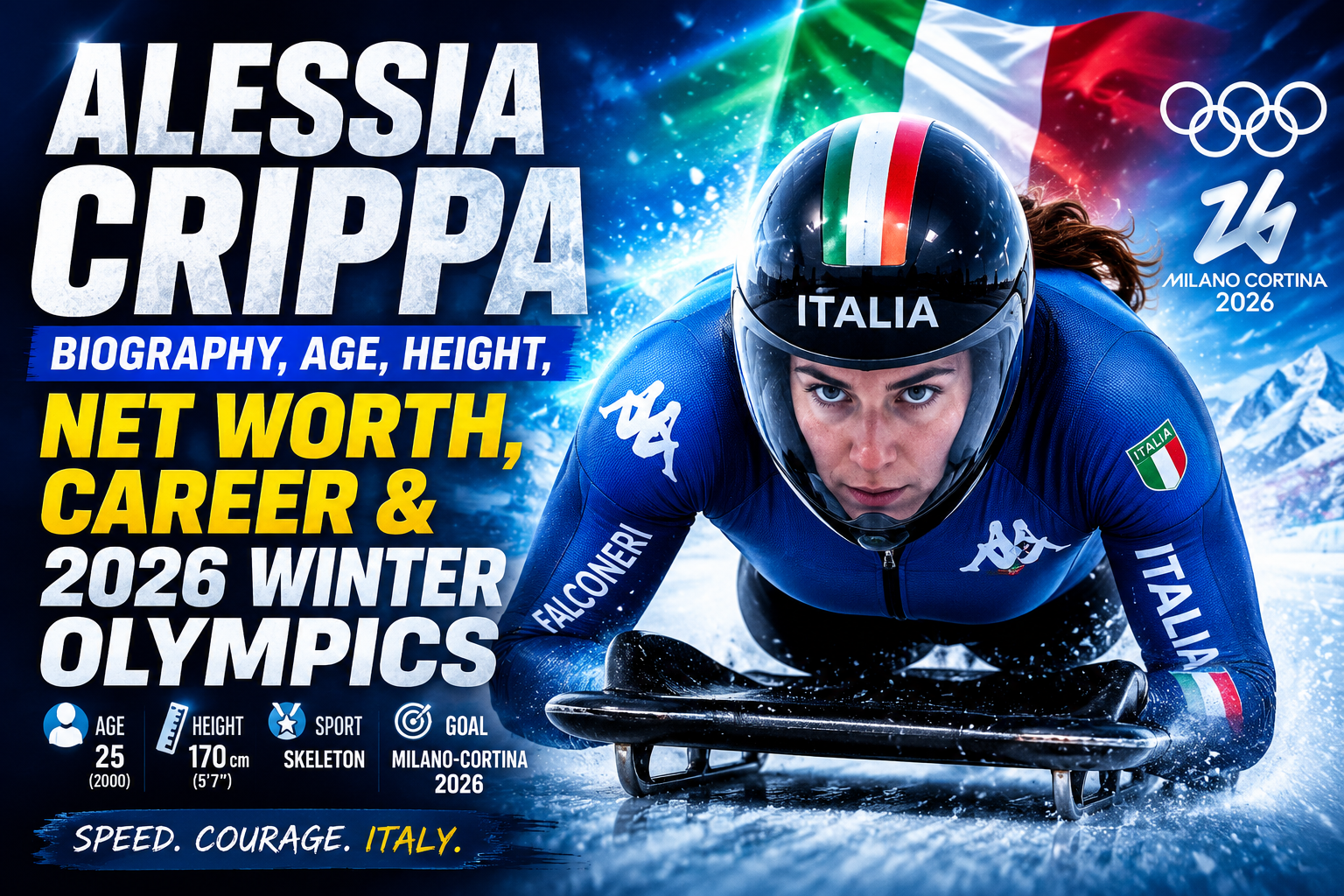
Alessia Crippa is 25 years old (born June 26, 2000) and stands 5 ft 2 in (157 cm) tall. She is an Italian professional skeleton racer who competed at the 2026 Milan-Cortina Winter Olympics — and she’s one of the most exciting young winter athletes Italy has produced in years.
Italy has always had a certain deep love, for winter sports, like for ages i guess. And among the new generation of Italian athletes that are really making their mark on the global stage, Alessia Crippa sort of stands out.
She’s a professional skeleton racer representing Italy, on the international IBSF World Cup circuit , and this sport asks for extraordinary courage, split-second reflexes, and years of relentless dedication too. It’s not just a thing you try, it’s a kind of stubborn commitment.
Article Contents
Alessia Crippa Biography
| Detail | Information |
|---|---|
| Full Name | Alessia Crippa |
| Date of Birth | June 26, 2000 |
| Age | 25 years old (2026) |
| Birthplace | Crodo, Province of Verbano-Cusio-Ossola, Italy |
| Nationality | Italian |
| Sport | Skeleton Racing |
| Height | 5 ft 2 in (157 cm) |
| Weight | Around 52 kg (114 lbs) |
| Birth Sign | Cancer |
| Eye Color | Blue |
| Relationship Status | Single |
| Military Affiliation | Aeronautica Militare |
| Net Worth | Est. $100,000–$300,000 (2026) |
| @ale_crippa | |
| Olympics | 2026 Milan-Cortina Winter Olympics |
Who Is Alessia Crippa?
Let’s start with a question most people have never thought to ask — what it feels like to fly headfirst down a mountain of solid ice at 145 kilometres per hour with no brakes?
Alessia Crippa does it for a living, .
Alessia Crippa Age 25-year-old Italian skeleton racer from the Alps in northern Italy. She’s been chasing that feeling since she was 15. While most teens were figuring out high school stuff, Alessia was up there strapping onto a tiny sled and learning to survive those corners, that would make most adults feel dizzy, just watching from the sideline.
She’s not exactly a household name. Not yet. But she did compete at the 2026 Milan-Cortina Winter Olympics, on home soil on an Italian mountain in front of Italian fans. And that’s the sort of moment that doesn’t land twice in a lifetime.
This is her full story.
Alessia Crippa Age and Early Life
Alessia was born on June 26, 2000, in Crodo. And if you’ve never heard of Crodo, well then you’re in good company — it’s this tiny mountain town in Verbano-Cusio-Ossola, tucked into Piedmont, right near the Swiss border. Population: small. Mountains: enormous.
Growing up in a place like that means winter sports are in your blood whether you like it or not.
She started with alpine skiing first. Made complete sense — mountain kid, fearless, natural feel for speed. But skiing wasn’t quite it. She also did athletics and track events on the side, sort of building that explosive leg power, the one that would later turn into her actual secret weapon on the ice.
Then she found skeleton. She was a teenager when she tried it for the first time — and something just clicked. That mix of raw speed, pinpoint body control, and the absolutely terrifying reality of hurtling face-first down a frozen chute at 90 miles per hour — it suited her perfectly. Some athletes spend years searching for their sport. Alessia found hers fast.
By January 2016, she was 15 years old and already racing in international European Cup events. Most athletes won’t get anywhere near that level until their later teens, at best.
What Even Is Skeleton?
Fair question. Skeleton really doesn’t get the attention it deserves. A lot of people only see it once every four years at the Winter Olympics, then kind of forget it’s there, like gone in a blink.
So here’s how it works.
You stand at the top of a frozen track — same type of track used for luge and bobsled. You sprint with your sled for about 30 to 50 metres. Then you dive face-down onto it and launch headfirst into the track.
No brakes. No steering wheel. Literally nothing.
All the control comes from your body. Tiny shoulder shifts. Pressure changes with your knees. Subtle weight adjustments on the sled. And those little adjustments— the sort you probably wouldn’t even notice from the stands — actually decide everything. Like whether you thread the line through a corner at 130 km/h or you just bounce off the wall, mis-aimed for reasons you can’t fully explain in the moment.
A complete run usually takes about 55 to 60 seconds. But in that window, you’re absorbing forces reaching roughly 5G through the tight bends. That’s the same “G” feeling fighter pilots get in combat turns. Only here, you’re doing it with your face, maybe six inches from the ice, staring straight at the track coming at you at that terrifying pace.
Alessia’s sled tops out at over 93 mph during competition. That’s on a good day.
Four runs over two days. Lowest combined time wins. Simple concept on paper. It’s absolutely brutal, especially when you’re in it.
And at the 2026 Milan-Cortina Games, there’s a brand new discipline making its Olympic appearance for the very first time — Mixed Team Skeleton. Two athletes, a male and a female, from the same nation, racing together as one unit. History was made on Alessia’s home track.
Alessia Crippa’s Career — From Mountain Kid to Olympian
Starting Out (2016)
She made her international debut in January 2016. Fifteen years old. European Cup. The same year, she entered the Italian Skeleton Championships.
Progress in skeleton is never quick. It can’t be. Every track in the world has its own personality — different corners, different speeds, different rhythm. Altenberg in Germany feels nothing like St. Moritz in Switzerland. Innsbruck is completely different from Sigulda in Latvia. Athletes spend years just learning individual tracks before they can truly compete at the top of them. It’s a slow sport to master. Alessia started early and stayed patient.
Junior Medals (2021 & 2022)
The patience paid off. Like, really. At the European Junior Championships she went back-to-back, silver in 2021, bronze in 2022. Two medals in two years, right at the top junior level in Europe, much.
Italy’s coaching staff had seen enough , they knew what they had. Italy’s coaching staff had seen enough. They knew what they had.
World Cup Debut (2020)
She broke into the IBSF World Cup in 2020. That is the absolute top tier of the sport— the circuit that sits just below the Olympics and World Championships in prestige, .
2025 World Championships — 19th Place
At the 2025 IBSF World Championships, Alessia finished 19th in the Women’s Individual event.
And here’s the thing, this is what that actually means. To even qualify for a World Championship in skeleton, you need to be among the best athletes on the planet. The women’s field has just 25 spots. So finishing 19th means she was the 19th best skeleton racer, on that day, in the world. That’s not really a letdown— it’s elite level opposition and the standard shows.
The Olympic Season — Cortina World Cup (November 2025)
The 2025–26 season was a different beast entirely , . Italy was getting ready to host the Winter Olympics, and every single athlete in the Italian skeleton program had this feeling , what was coming.
In November 2025 , the IBSF started its World Cup season at the Eugenio Monti Sliding Center in Cortina d’Ampezzo. Same track, the one that would host the Olympics just a few months later, like three months, give or take. It had been completely rebuilt , and not in a small way—now 1,445 metres long, nearly 100 metres more than the older layout, with 16 corners instead of 11. People who trained there in November said it was among the most technical and demanding tracks across the world , kind of ruthless in its own way.
Alessia Crippa was selected as one of six Italian athletes to compete there. Six , that’s it. That was the number of positions Italy’s coaching staff reserved for home athletes— and Alessia was in that group too.
February 2026 — The Milan-Cortina Winter Olympics
Home soil. The biggest event in winter sport. February 2026.
The Women’s Skeleton ran across February 13 and 14 at the Cortina Sliding Centre, with 25 athletes from 17 countries. Austria’s Janine Flock — fourth Olympics, first gold — won in emotional fashion. Germany swept silver and bronze through Susanne Kreher and Jacqueline Pfeifer.
But the results table only tells half the story.
Racing at a home Olympics is something most athletes never experience once in an entire career. The crowd cheers your name. The flag on your suit means something completely different to how it feels abroad. The mountain is yours. Cortina is yours. For Alessia and Italy’s skeleton team, February 2026 wasn’t just another competition. It was something they’ll carry for the rest of their lives.
Alessia Crippa Height, Weight, and Physical Profile
Alessia stands 5 feet 2 inches tall — 157 cm — and weighs around 52 kg.
In skeleton, size is less important than most people assume. A lower center of gravity actually helps stability through certain corners. But what truly makes or breaks a skeleton racer — especially at the elite level — is the push start.
That’s the explosive sprint of 30 to 50 metres at the top of the track before the athlete launches onto the sled. It lasts only a few seconds. But those few seconds echo through the entire run. A push that’s one tenth of a second faster can hand you a full second advantage by the time you hit the finish. In a sport where races are decided by hundredths, that’s an enormous difference.
Alessia’s years of athletics and track training built exactly the kind of explosive start speed that skeleton coaches look for. It’s her background. It’s her edge.
She trains twelve months a year without stopping. Winter means ice and competition. Summer means sprinting, strength work, and gym sessions — staying sharp for when the season comes back around.
Alessia Crippa Personal Life and Instagram
Alessia is sort of private about her personal life, like she does not really get into it much. She’s 25, she is single, and she rarely talks publicly about relationships. For elite athletes at that level it’s normal, when your sport requires that much attention, everything else ends up taking a back seat, even if you want it to not.
What she does share, though, is the racing part of her life. On Instagram, @ale_crippa, she posts those race moments, training stuff and little glimpses of what day to day life really looks like when you are a professional winter athlete.
Her TikTok has really blown up in a way I think she probably did not expect. Like one video where she’s racing on the ice, it got over 2.2 million likes. Fans started calling her “Italy’s Ice Queen” and the nickname just stuck there.
Watch one of her runs and you’ll see why.
Alessia Crippa Net Worth
Okay, let’s be straight about this — skeleton racing isn’t the NBA. Nobody in this sport is buying a villa from prize money alone.
Alessia’s estimated net worth in 2026 is between $100,000 and $300,000. That comes from a few different places. Her affiliation with Aeronautica Militare — the Italian Air Force’s elite sports group — provides her with a salary and full training infrastructure. That’s actually a solid setup for a winter athlete. It means she trains full-time without financial pressure hanging over her.
Add in World Cup prize money and whatever sponsorship deals she has in place, and that gives you the overall picture.
Most skeleton athletes aren’t in this sport for financial reasons. The prize pools are modest compared to mainstream sports. They do it because nothing else in life compares to what it feels like going face-first down a frozen mountain at 150 km/h.
As her career grows — and particularly if World Cup podiums start coming — the net worth figure will climb with it.
Career Highlights
| Year | Achievement |
|---|---|
| January 2016 | International debut at European Cup — age 15 |
| 2016 | Entered Italian Skeleton Championships |
| 2020 | IBSF World Cup debut |
| 2021 | Silver medal — European Junior Championships |
| 2022 | Bronze medal — European Junior Championships |
| 2025 | 19th place — IBSF World Championships |
| November 2025 | Selected for Italy’s home squad at Cortina World Cup |
| February 2026 | Competed at 2026 Milan-Cortina Winter Olympics |
Frequently Asked Questions
How old is Alessia Crippa? Born June 26, 2000 — she’s 25 years old in 2026.
How tall is Alessia Crippa? 5 ft 2 in (157 cm), weighing around 52 kg.
What sport does Alessia Crippa do? Skeleton racing. Face-down, head first, no brakes, up to 145 km/h. She runs on the IBSF World Cup, European Cup, and Intercontinental Cup rounds for Italy , .
Did she compete at the 2026 Winter Olympics? Yes. She also was with Italy’s skeleton crew at the Milan-Cortina Games in February 2026 , taking place at the Cortina Sliding Centre in Cortina d’Ampezzo .
What is Alessia Crippa’s net worth? Estimated $100,000 to $300,000 in 2026. Earned through Aeronautica Militare support, IBSF prize money, and sponsorships.
What’s her Instagram? @ale_crippa — racing moments, training clips, and personal content.
Where is she from? Crodo, a small mountain town in Verbano-Cusio-Ossola, northern Italy — right up near the Swiss border in the Alps.
What is Aeronautica Militare? The Italian Air Force’s elite sports group. They support top national athletes — including Alessia — with salaries, training facilities, and full logistical backing. It’s a well-established system in Italian winter sport.
Alessia Crippa reached the World Championship
Alessia Crippa is 25 years of age. She grew up in a very small Alpine hamlet , like tiny. As a teenager she ran into skeleton, and once it clicked she kind of didn’t look back again. She’s already taken junior medals, she reached the World Championship scene, made the World Cup circuit and even showed up for the home Olympics, February 2026.
Not bad for someone the majority of the world still hasn’t really heard of.
She’s not finished either. Not by a long shot. The podium runs at World Cup level are coming — the foundation is already there. Two European Junior medals don’t lie.
The best chapters of Alessia Crippa’s career haven’t been written yet. Follow along at @ale_crippa on Instagram. You’ll want to be watching when they are.

Genie Bouchard: Biography, Tennis Career & Net Worth
Genie Bouchard is the first Canadian player to win a Grand Slam. This distinction and a No. 5 world ranking…

Tara Davis-Woodhall: Biography, Long Jump Career & Net Worth
Tara Davis-Woodhall is the reigning Olympic gold medalist and current world No. 1 in the women’s long jump, known as…
Sonay Kartal: Age, Height, Ranking and the Comeback That Reached
British player Sonay Kartal was born in 2001. When she qualified for the final of the Wuhan Open in October…

Brittany Mahomes: Biography, Soccer Career & Net Worth
Brittany Mahomes built a career in soccer long before she became known as Patrick Mahomes’ wife — a college career…
Maja Chwalinska: Age, Height, Ranking and the Qualifier Who Reached
Maja Chwalinska, 25, is a Polish tennis player ranked world No. 22. Her breakthrough came in 2026, when she reached…

Kumkum Mohod: Age, Asian Games Gold and the Rise of
Kumkum Mohod, a 17-year-old recurve archer from Amravati, Maharashtra, made history when she won India’s first individual recurve gold at…
2 thoughts on “Alessia Crippa: Age, Height, Net Worth & Biography (2026)”