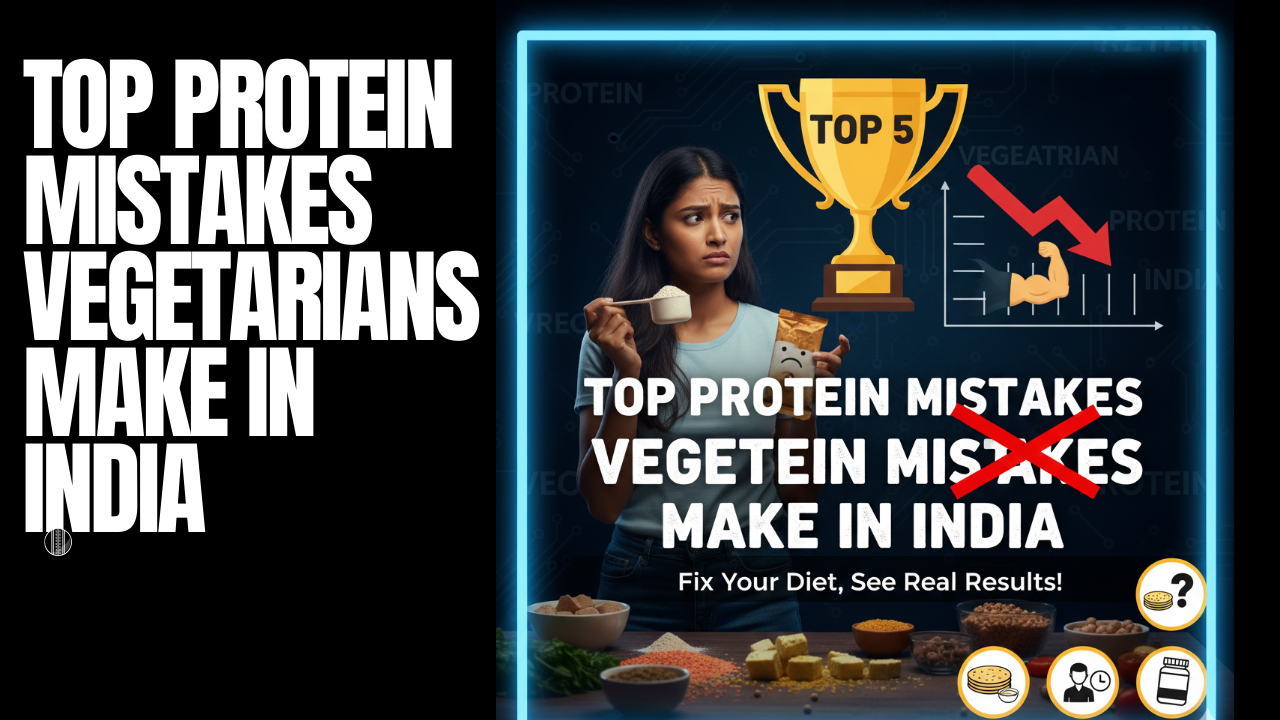
Top Protein Mistakes Vegetarians Make in India – Being vegetarian in India gives you a huge culinary advantage — dals, paneer, sprouts, and soya are everywhere. Still, many vegetarians unintentionally undercut their protein goals. Small missteps add up. Fix them, and you’ll feel fuller, perform better at work and workouts, and protect muscle as you age. Here are the most common protein mistakes — and how to fix them fast.
Article Contents
1. Top Protein Mistakes – Relying on one “go-to” (paneer or milk)
Paneer and milk are great, but consuming them in every meal diminishes variety in your diet. This protein source is a protein puddle of unique amino acid breadth and depth. The a week rotational menu solution is dal, soya, paneer, tofu, sprouted legumes, and a useful assortment of nuts and seeds.
2. Top Protein Mistakes: Overestimating portions and protein content
People often assume “a bowl of dal = protein done.” Reality: portions, cooking losses and serving sizes matter. That bowl helps, sure — but it may not meet your target alone.
Fix: combine protein sources in a meal — dal + paneer, or sprouts + nuts — and use simple portion rules (protein at each main meal).
3. Top Protein Mistakes: Skipping protein at breakfast
Toast or cereal is a weak solution to sustain hunger. When breakfast is rich in carbs, and a complete protein is absent, then snacking abroad or at the office becomes a reflexive hunger snacking mechanism.
Fix: add eggs, Greek yoghurt, moong chillas, sattu, or a small protein shake to your morning.
4. Top Protein Mistakes: Not mixing plant proteins across the day
The old “complementary protein” panic (mix two foods in one meal) is overblown, but variety still matters across the day. One lentil dish is unreasonably expected to magically cover all deficient protein gaps. The solution is obtaining and digesting distinct plant proteins interspersed or within the 24 hours, legumes in one meal, dairy in another, and teaming any snacks with protein- nutrient rich seeds or soya.
5. Neglecting absorption & pairings
Non-heme iron and some plant minerals need help. Drinking chai with a heavy dal meal or not using citrus at all will lead to absorption impediments. The remedy is consuming vitamin C (lemon, tomato, orange) rich foods alongside iron-abundant plant foods. When it’s your meal with iron-rich foods, avoid tea or coffee.
6. Treating supplements as a shortcut
Top Protein Mistakes people make in India Powders and pills can be useful. But they’re often used without testing or real need — and then blamed when results don’t show.
Determine (B12, vitamin D, and iron) status before supplementation. Occasional convenience products should have quality and a short ingredient list instead of being used as a daily crutch.
7. Poor timing for active people
If you train and then wait hours to eat protein, muscle recovery slows. Timing matters more if you’re strength-training.
Fix: include a quick post-workout protein source — dairy, soya shake, egg whites, or a simple paneer snack.
Mini-interview (real-feel)
Q: What Top protein mistake did you make?
A: “I thought mango lassi counted as protein because it’s milk-based. Turns out I was under-eating protein all week,” admits Riya, an MBA student in Pune. “Once I added a boiled egg or sprouts to breakfast, midday energy stopped crashing.” Small change. Big difference.
Quick checklist — how to stop under-eating protein
- Every major meal should be required to have a protein input.
- Plan ahead, and, if possible, prepare and portion soya, dal, and paneer dishes so they last throughout the week.
- On-the-go snacks can mean you’ve got roasted chana or nuts to hand.
- If low energy is a concern, testing vitamin D and B12 is a good idea. Amplifying the benefits of the above can be worthwhile, at least with moderation, for any additional consumed powders.
Can vegetarians have enough protein without supplementation? Is it possible?
Definitely, And it is possible. It can be done with some variety which is generally obtainable through a rotational menu with dals, paneer, soya, seeds, nuts and dairy.
How much protein per meal is enough?
Aiming targets vary with age and energy activity levels, so it is hard to quantify. As a reasonable benchmark, and practical guide, it is better to include a reasonable portion at all mealtimes, rather than banking on just one meal to be a total daily protein solution to all meal needs.
Is sprouted moong really better?
Moong sprouting boosts both digestibility and nutrient absorption. You’re getting a lot of bang for your buck with this simple addition to your meal.

Ananya Birla Biography: Age, Education, Husband, Net Worth, Entrepreneur Journey
Ananya Birla has become one of the most influential young entrepreneurs and public figures in India. People anticipated that she…

RCB vs SRH IPL 2026 Match 1 Preview: Pitch Report,
The wait is finally over because IPL 2026 is now beginning with its first match which features Royal Challengers Bengaluru…

How to Watch IPL 2026 Live Anywhere — Official Broadcast
The Indian Premier League (IPL) 2026 returns with its full T20 spectacle and fans throughout the worldneed to learn How…

Navdeep Saini Replaces Harshit Rana IPL 2026 — KKR Ahead
Kolkata Knight Riders (KKR) received a major blow just weeks ahead of 2026 Indian Premier League (IPL) after their promising…

Kal Somani: The Tech Entrepreneur Behind the $1.63B Rajasthan Royals
In a landmark moment for global cricket and sports business, Kal Somani has surged into the international spotlight as the…

Sara Saffari Profile, Stats & Bio (2026): Net Worth, Height,
Now talk about Sara Saffari profile stats bio: Sara Saffari has achieved rapid fame through social media platforms which currently…