
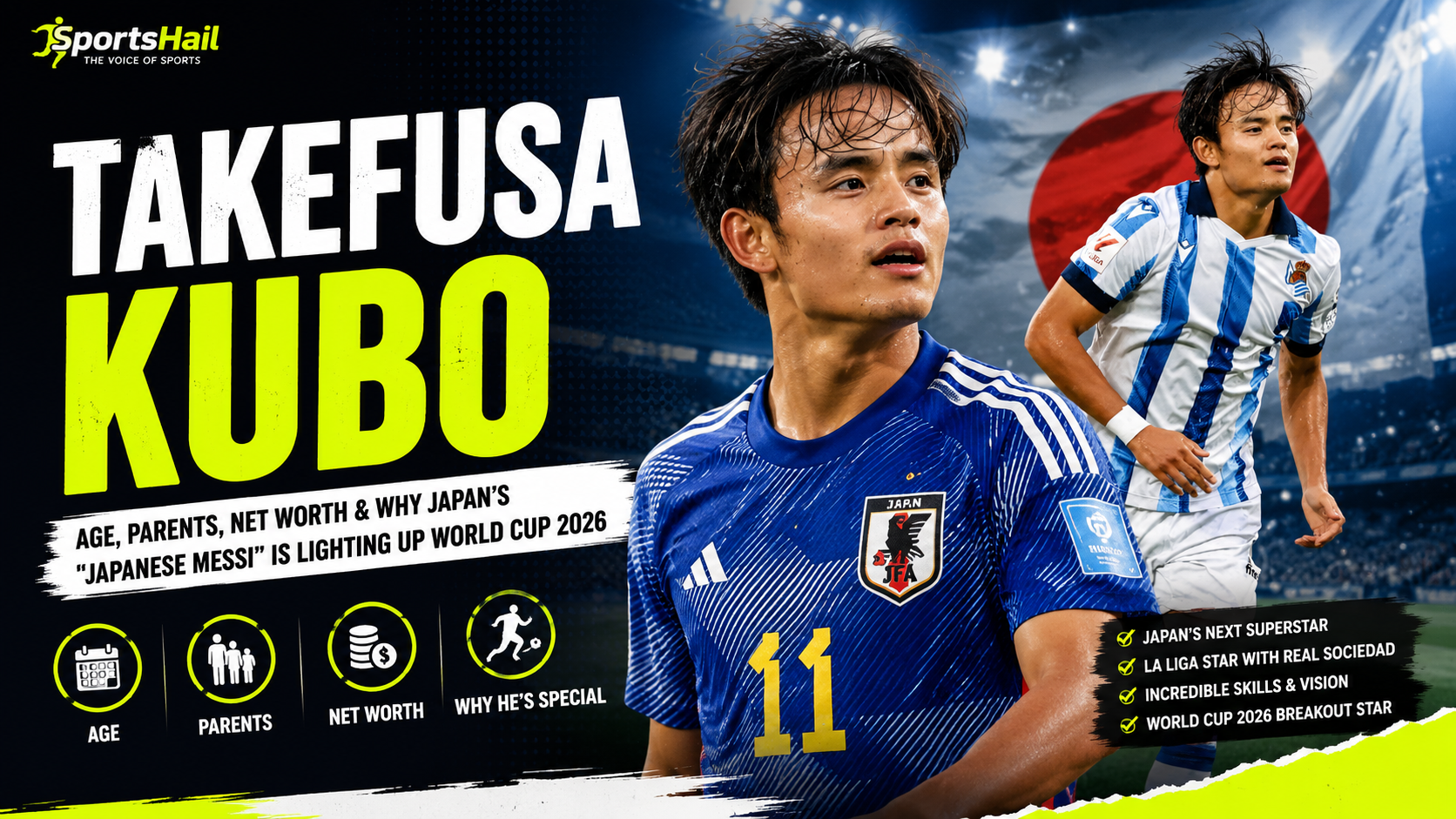
The nickname tells you everything and also nothing, kinda.
“The Japanese Messi.” It’s been doing that since Takefusa Kubo was eight. You know, that tiny kid from Kawasaki, who walked into an FC Barcelona soccer camp in Japan, picked up MVP and then left like, “yeah ok,” with an invitation to join La Masia. Barcelona’s La Masia. The same place that actually produced Messi, not just stories about it.
Now he’s 25, plays for Real Sociedad in La Liga, and he represents Japan at the 2026 FIFA World Cup in North America. Match after match, slowly but surely, he’s making it clear that the nickname wasn’t only noise or hype. It was an early read, on a genuinely special footballer.
So, let’s break down who Takefusa Kubo really is, where he came from, and why basically everyone is paying attention to him right now, especially at this World Cup.
Article Contents
Takefusa Kubo Biography
| Detail | Info |
|---|---|
| Full Name | Takefusa Kubo (久保 建英) |
| Nickname | Take, The Japanese Messi |
| Date of Birth | June 4, 2001 |
| Age | 25 years old |
| Place of Birth | Asao-ku, Kawasaki, Kanagawa, Japan |
| Height | 1.73 m (5 ft 8 in) |
| Nationality | Japanese |
| Father | Takefumi Kubo (also a footballer) |
| Preferred Foot | Left |
| Position | Right Winger |
| Current Club | Real Sociedad (La Liga) |
| Jersey Number | 14 |
| Weekly Wage | €100,000 per week (estimated) |
| Net Worth | ~$10 million (estimated, 2026) |
| Languages | Japanese, Spanish, English |
Takefusa Kubo Early Life — A Football Obsession That Started in Kawasaki
Takefusa Kubo was born June 4, 2001 in Asao-ku, a district in Kawasaki, Kanagawa Prefecture. His father is Takefumi Kubo and he played football too. Not really at the absolute top level, but still enough to see the game from a more grounded angle and, earlier than most, realize that his son was a little different.
Kubo started properly kicking a ball around age seven, joining FC Persimmon, a local club close to where he lived. From the beginning he stood out, like not even slightly. Low centre of gravity, fast feet, comfortable on both sides, but with this especially sharp left foot. And he was… fearless, in those one-on-one situations that usually make other kids freeze. By the time he was eight, people had already started noticing.
Then, came the part that basically turned the page.
In 2009, the eight-year-old Takefusa Kubo went to an FC Barcelona Soccer Camp that was being held here in Japan. He was the best player there, by a distance, like it wasn’t even close. No real contest, just him. He won MVP and Barcelona’s scouts took notice immediately. What followed was an invitation to join La Masia — the most famous youth academy in world football — and a decision that would shape the rest of his life.
He moved from Japan to Spain permanently at age ten. On his own. At ten years old. In a foreign country, speaking a language he was still learning. That level of mental resilience at that age is almost impossible to overstate.
La Masia and the FIFA Ban That Changed Everything
After that, Kubo spent four years in La Masia and he was special basically from day one. In the 2012-13 season, playing for Barça’s Aleví C side, he netted 74 goals in 30 matches… or something like that, but yeah, the number was wild, and it stuck with scouts games. Seventy-four. In one season. At ten years old. The coaches at La Masia had watched thousands of promising kids, and they were honestly surprised by what this quiet Japanese boy could do with a football.
But in 2015, everything sort of collapsed. FIFA sanctioned FC Barcelona for breaking international transfer rules about players who were under 18. As a direct consequence, Kubo — along with several other foreign youth players — was forced to leave La Masia and return to his home country. He was 13 years old. So he had to gather up his whole life in Spain and return to Japan, leaving behind the academy that he’d basically given everything to, like day after day.
It was genuinely crushing. But here’s what separates the great ones from the rest — instead of falling apart, Kubo came back stronger.
He returned to Japan and signed with FC Tokyo’s youth system, eventually making his professional debut for FC Tokyo U-23 in 2017 at just 15 years old — becoming the youngest ever J-League scorer in the process.After that, he had a short loan spell with Yokohama F. Marinos, and then the European powerhouses came back again. This time it was Real Madrid.
Takefusa Kubo Real Madrid — The €2 Million Teenager
In June 2019, Takefusa Kubo signed for Real Madrid on a five-year contract. He was 17 years old. Real Madrid. One of the most famous clubs on the planet.
But there was a catch — because Barcelona had registered him as a youth player, Real Madrid faced similar FIFA restrictions on using him immediately. He spent his time at the club on a series of loan spells that were, in many ways, the making of him as a professional.
Mallorca. Villarreal. Getafe. Granada. Back to Mallorca. After that came five loan stints in four seasons, with different squads, different managers, different tactical setups, and different expectations. Most players would get unsettled by that kind of bouncing around. Kubo handled it like a schooling moment. He reshaped his approach at each club, took in varied tactical thoughts, and ended up on the other side as a more complete, more flexible, and more physically sturdy footballer.
At Villarreal in 2020-21, he was really impressive 6 goals and 4 assists in La Liga, and he played his role in the club’s remarkable Europa League winning run that season. His Mallorca loan during 2021-22 then delivered 7 goals across 32 La Liga appearances. The quality was obvious. The question was always: where would he settle permanently?
Takefusa Kubo Real Sociedad — Finally, a Home
Then in July 2022, Takefusa Kubo kind of made history, by being the first Japanese player to join Real Sociedad in a permanent way, for a deal that was reported to be around €6 million, give or take. And on his debut, in their very first La Liga match against Cádiz, he scored the only goal, in a 1-0 win. Classic Take Kubo.
The 2022-23 season was, by quite a margin, his best spell in Spain. He ended up notching 10 goals, and serving up 11 assists in La Liga , numbers that genuinely put him among the sharper wingers in the division. After that, he was named La Liga Player of the Month in September 2023. Also, he struck against Real Madrid at the Bernabéu in a moment where the whole stadium , including Madrid supporters, quietly admired what they were seeing.
Now fast forward to 2025-26, Kubo came on as a substitute in the Copa del Rey final and helped Real Sociedad get past Atletico Madrid on penalties, to lift the trophy— their fourth Copa del Rey title ever. He already had a Copa del Rey winner’s medal in his hand, adding to a growing pile of achievements, before the World Cup had even started.
He wears the number 14 shirt at Sociedad. He speaks fluent Spanish — like actually fluent, not that tourist-level sort of Spanish, and on top of that he also speaks English. Honestly, his teammates seem to really like him. The Sociedad fans love him. And increasingly, the whole of La Liga has learned to fear him.
Takefusa Kubo Japan — From U-15 to World Cup Star
Kubo has represented Japan at every level from U-15 upwards. For context, he made his senior Japan debut in 2019 at 17 years old, one of the youngest ever to do it, at the Copa América in Brazil. Then he was in the Tokyo Olympics in 2021. He also featured at the 2022 World Cup in Qatar, where Japan famously beat Germany and Spain in the group stage, one of those great upsets that people still talk about.
And now World Cup 2026. Japan are in Group F with the Netherlands, Sweden and Tunisia. Kubo is central to nearly everything Hajime Moriyasu wants Japan to do, that is the real point. His knack for taking the ball in narrow zones, beating defenders in direct one-on-one duels, and manufacturing chances out of basically nothing makes him a perfect weapon for a Japan side that leans on clever, high-intensity pressure and quick transitions.
Against the Netherlands in Japan’s first group match, Kubo was Japan’s most dangerous player for the whole game. He didn’t land the goal his display deserved, but his off-ball movement kept creating space for teammates, and it kept one of the world’s best defences off balance for long stretches. So, there is more to come from him here, and not the small kind either. Significantly more.
Takefusa Kubo Career Stats
| Season | Club | Apps | Goals | Assists |
|---|---|---|---|---|
| 2020–21 | Villarreal (loan) | 33 | 6 | 4 |
| 2021–22 | Mallorca (loan) | 32 | 7 | 3 |
| 2022–23 | Real Sociedad | 38 | 10 | 11 |
| 2023–24 | Real Sociedad | 35 | 8 | 7 |
| 2024–25 | Real Sociedad | 38 | 9 | 8 |
| 2025–26 | Real Sociedad | 30 | 2 | 4 |
| Japan (senior) | National Team | 49+ | 7 | 12 |
How Much Is Takefusa Kubo Net Worth?
Kubo net worth is estimated at around $10 million in 2026, though the numbers always sort of wobble a bit depending on the source. His weekly wage at Real Sociedad sits at roughly €100,000 per week which comes out to about €5.2 million per year, so yeah, he is definitely among the highest-paid players in the club’s history.
On top of that, he has endorsement deals with Adidas and a bunch of Japanese brands, not just one or two. On Transfermarkt, his market value is currently shown at approximately €55–65 million as of June 2026. And there are these ongoing reports about Premier League interest, plus German sides too—honestly, a strong World Cup showing will only feed the speculation, more and more.
He is 25 now, so he is stepping into those peak years of his career, the kind where performances, minutes, and contract power tend to rise together. The money side is pointing pretty firmly upward, it seems pretty clear.
Takefusa Kubo Personal Life
Kubo keeps his personal life extraordinarily private. There is no confirmed girlfriend or partner publicly known. He has given interviews saying his sole focus is football — and given the life he has lived, moving countries at age ten, navigating loan spells across five different clubs, that singular focus is probably what has kept him on track through everything.
He speaks three languages — Japanese, Spanish, and English — which makes him genuinely unique among footballers of his generation. His Spanish is reportedly so good that his Sociedad teammates sometimes forget he’s Japanese. He’s been in Spain since he was ten, so it makes sense — but it’s still remarkable.
Off the pitch he’s quiet, focused, and private. No controversies. No drama. Just football.
Fun Facts About Takefusa Kubo
He scored 74 goals in 30 games for FC Barcelona’s youth team at age ten. That number isn’t a typo. Seventy-four goals. In thirty games.
He was forced to leave La Masia at 13 due to FIFA sanctions on Barcelona — not because of anything he did wrong. He came back from that and signed for Real Madrid four years later.
He speaks Spanish so fluently that his Real Sociedad teammates regularly forget he’s Japanese, according to multiple interviews with club staff.
Japan beat Germany and Spain in the same World Cup group in Qatar 2022 — with Kubo as one of the key players. He was 21 years old.
He won the Copa del Rey with Real Sociedad in April 2026 — coming off the bench in the final against Atletico Madrid — just weeks before the World Cup began.
He’s been called “the Japanese Messi” since he was eight years old. He’s never complained about the comparison. He’s just quietly gone about trying to justify it.
Why Everyone Should Be Watching Takefusa Kubo at World Cup 2026
Japan are not supposed to go deep at this World Cup. The Netherlands are in their group. Sweden are solid. The expectation from the outside world is that Japan do well but ultimately fall short.
But Japan have surprised the outside world before. Qatar 2022. Germany. Spain. Both beaten in the group stage. Nobody saw that coming either.
And at the centre of everything Japan do in attack is Takefusa Kubo. The kid who moved from Japan to Spain at ten. Who was kicked out of La Masia at 13 and didn’t give up. Who went through five loan spells and came out the other side as one of La Liga’s most dangerous wingers. Who speaks three languages and wins Copa del Reys and plays World Cups for Japan.
The nickname has followed him for seventeen years. And honestly? He’s earning it more with every passing season.
Watch him. You won’t regret it.

Red River Rivalry 2026: Texas vs Oklahoma Date, TV, Prediction
Red River Rivalry 2026: Texas vs Oklahoma date, kickoff time, TV channel, key storylines and our prediction for the October…

Liberty vs Dream Prediction 2026: WNBA Semifinals Odds, Schedule &
Liberty vs Dream prediction for the 2026 WNBA semifinals: schedule, odds, players to watch and our pick for the series…

Cowboys vs Texans Prediction: Week 4 Odds, Porter Debut &
Cowboys vs Texans prediction for NFL Week 4: odds, injury report, Joey Porter Jr. debut status and our pick for…

Yankees vs Rays ALDS Prediction 2026: Pitchers, Schedule & Pick
Yankees vs Rays ALDS prediction for 2026: schedule, probable pitchers, key factors and our pick for the Division Series starting…

Joey Porter Jr. Trade Grades: Cowboys vs Steelers, Who Won?
Joey Porter Jr. trade grades: the Cowboys send a 2028 second-round pick and a 2027 sixth-round pick to the Steelers….

Livvy Dunne Biography: Age, Net Worth, Height & Life After
Livvy Dunne is a former LSU gymnast. She later became one of the most recognizable names in college sports during…
1 thought on “Takefusa Kubo: Age, Parents, Net Worth & Why Japan’s “Japanese Messi” Is Lighting Up World Cup 2026”