
Botswana’s population is smaller than lots of big cities. For a long time, hearing that the country had an Olympic sprint medal felt like a party-game question that no one takes seriously. Then Letsile Tebogo came along. He made that old joke pointless. He turned a place with little sprint history into a real 200m threat. He did it while racing the best group the event has seen in a long time.
Article Contents
Who Is Letsile Tebogo?
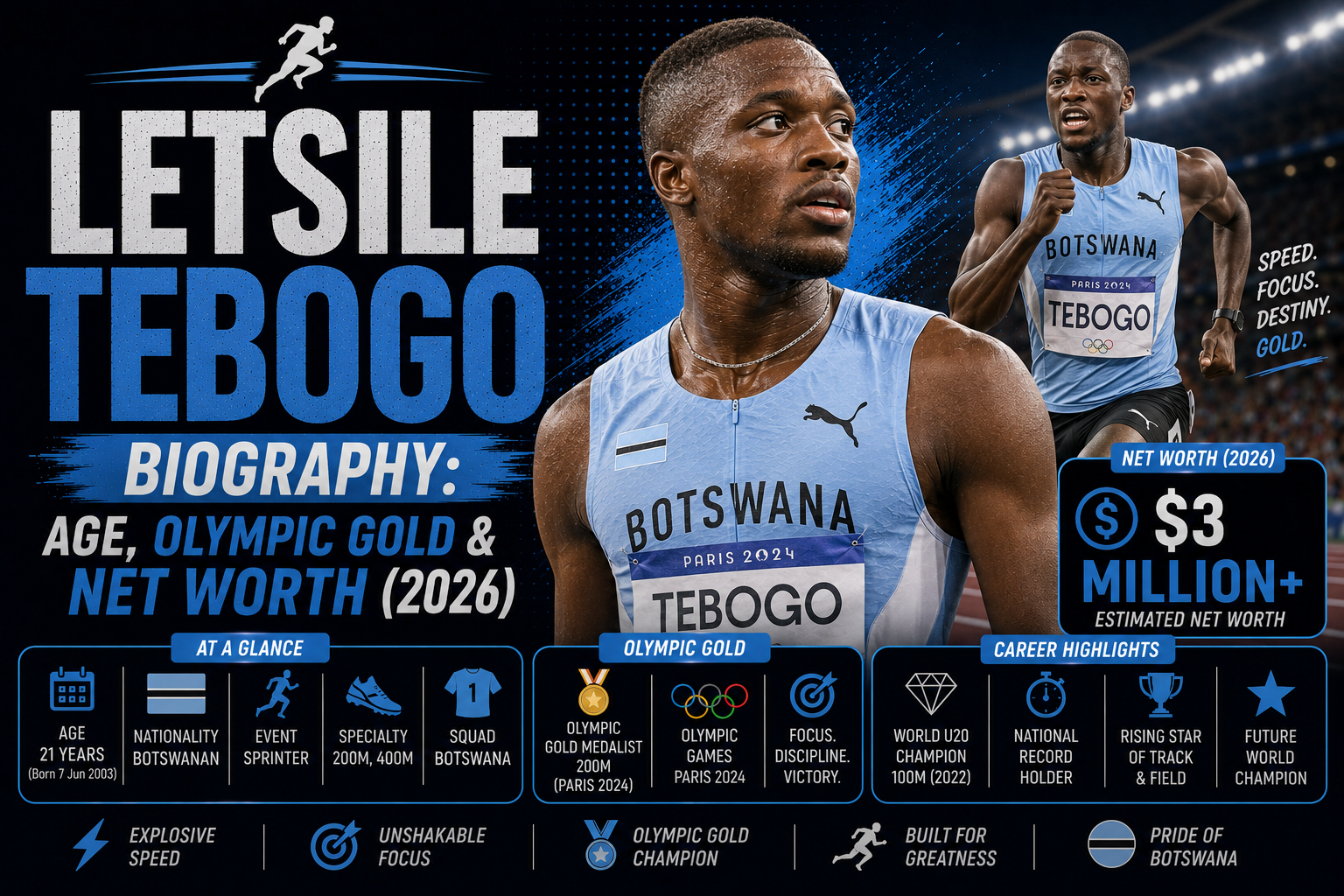
Letsile Tebogo is a sprinter from Botswana. In recent seasons he has become a surprise name on the world track scene. He won a major Olympic sprint race. He also brought home his country’s first personal Olympic gold medal at the individual level. His climb stands out because Botswana had almost no record of top sprint results on the global stage. Now Tebogo has become one of the toughest runners in the 200m.
| Full Name | Letsile Tebogo |
| Profession | Professional Sprinter |
| Date of Birth | June 7, 2003 |
| Birthplace | Kanye, Botswana |
| Events | 100m, 200m |
| Major Titles | Olympic gold (200m), Botswana’s first individual Olympic gold medalist |
| Nationality | Botswanan |
| Estimated Net Worth | $1-3 million (estimated, appearance fees + endorsements) |
Letsile Tebogo Age and Early Life
Tebogo was born on June 7, 2003, in Kanye, Botswana. Growing up there meant fewer training resources. There was less money for sports. There were fewer sponsors. Access to regular high-level meets was limited too. Compared with places like Jamaica and the United States, Botswana had a thinner support system for sprinting. That made his junior-level performances even more notable — he set global age-group records as a teenager that immediately put international scouts and rival federations on notice, well before he’d competed at a senior Olympic Games.
Letsile Tebogo’s Olympic Breakthrough
His Olympic 200m win was more than a win on a resume. It was the first for Botswana in an individual Olympic event. That detail carries weight. Botswana had never had an individual Olympic champion in any sport before. Tebogo earned the title against runners backed by bigger budgets. Many of them came from countries with deeper youth programs and stronger sprint pipelines. Because of that, the result feels earned, not random. It was not a lucky day or a weak field.
It was a statement that the sprinting world’s traditional geographic hierarchy was no longer guaranteed. Track and field has occasionally produced surprise medalists from unexpected countries before, but rarely has one gone on to become a genuine, repeat threat at the very top of a marquee event rather than a one-off underdog story that fades after a single Games.
What Botswana’s Sprint Program Did Differently
Tebogo’s rise didn’t happen in isolation. Botswana’s athletics federation invested meaningfully in relay program development over the preceding years, building depth in the men’s 4x400m program specifically that gave young sprinters like Tebogo access to serious international competition and coaching resources earlier than they might have received in a program built solely around individual events.
That relay-first investment strategy, somewhat unusual compared to how bigger athletics nations typically structure their development pipelines, turned out to be a genuinely effective way to fast-track individual talent by exposing it to championship-level pressure sooner.
Letsile Tebogo’s Rivalry With the World’s Best Sprinters
Running in the same years as big names, like Noah Lyles, made Tebogo’s rise get noticed right away. It turned into a headline rivalry instead of a slow story that needed years to build a fan base. Beating established stars on the sport’s biggest stage, rather than simply improving steadily in lower-profile meets, is what turned Tebogo from a name serious track fans were tracking into a mainstream headline.
That kind of head-to-head credibility against the sport’s most decorated active sprinters is difficult to manufacture through rankings or times alone — it has to happen on the track, under championship pressure, and Tebogo delivered it on the biggest stage available.
Letsile Tebogo’s Impact Back Home in Botswana
The reaction inside Botswana following his Olympic win reportedly amounted to a level of national celebration usually reserved for World Cup wins in football-mad countries — a genuinely unifying moment for a nation of roughly two and a half million people watching one of their own beat the sport’s traditional powers. That kind of result tends to produce a measurable bump in youth sports participation and government investment in athletics infrastructure, the same pattern seen in other countries after a breakthrough individual medal reshapes what young athletes believe is realistically possible for someone from their own country.
Letsile Tebogo’s Technical Strengths as a Sprinter
What separates Tebogo from a pure speed merchant is his acceleration pattern through the middle of the 200m — the phase of the race where most sprinters either hold their top-end speed or start losing it, and where genuinely elite 200m runners actually gain relative ground on the field. The first part of his race is the standout.
He handles the bend well, where staying smooth and efficient is hard. Coaches and commentators have mentioned how clean that phase looks for someone his age. That kind of sharpness usually takes more time for young sprinters. He also seems steady off the track. In the call room and at the blocks, he looks calm. His tone does not match how young he is compared to others. Put together, these signs point to the idea that his top marks could still come later, not that he has already hit his peak.
Letsile Tebogo Net Worth
Track and field doesn’t pay at football or golf levels even for Olympic champions, so treat any figure here as an informed estimate. Combining Diamond League appearance and prize money, Olympic-related bonus payments from his national federation, and a growing endorsement portfolio following his breakthrough win, financial estimates place his net worth in the $1-3 million range — a figure likely to keep climbing given his age, his continued presence at the top of major finals.
since his breakthrough, and the global attention his Olympic run generated across markets that rarely pay close attention to Botswanan sport. For his official competition results and progression, see World Athletics’ official records database, and for details on the Olympic event itself, the official Olympics athletics page maintains historical results across every Games.

Kumkum Mohod: Age, Asian Games Gold and the Rise of
Kumkum Mohod, a 17-year-old recurve archer from Amravati, Maharashtra, made history when she won India’s first individual recurve gold at…

Sree Charani: Age, Height, Stats and the Record-Setting Rise of
Sree Charani, a left-arm bowler from Andhra Pradesh, is currently the top-rated bowler in the history of ICC Women’s T20I…

Emily Austin: Biography, Career & Net Worth
Emily Austin turned a pandemic-era Instagram Live series into a career as one of the most recognizable young faces in…

Sky Brown: Biography, Skateboarding Career & Net Worth
Skateboarding phenomenon Sky Brown became Britain’s youngest-ever Olympic medalist at 13 years old. Her remarkable career achievements also include a…

Kinsey Wolanski: Biography, Age, Height, Career & Net Worth
Kinsey Wolanski gained recognition as a model and social media personality for disrupting the 2019 Champions League Final and subsequently…

Rachel Stuhlmann: Age, Height, Boyfriend, Tennis Career & Net Worth
Rachel Stuhlmann is an American tennis media personality and a former NCAA Division I player at the University of Missouri….