
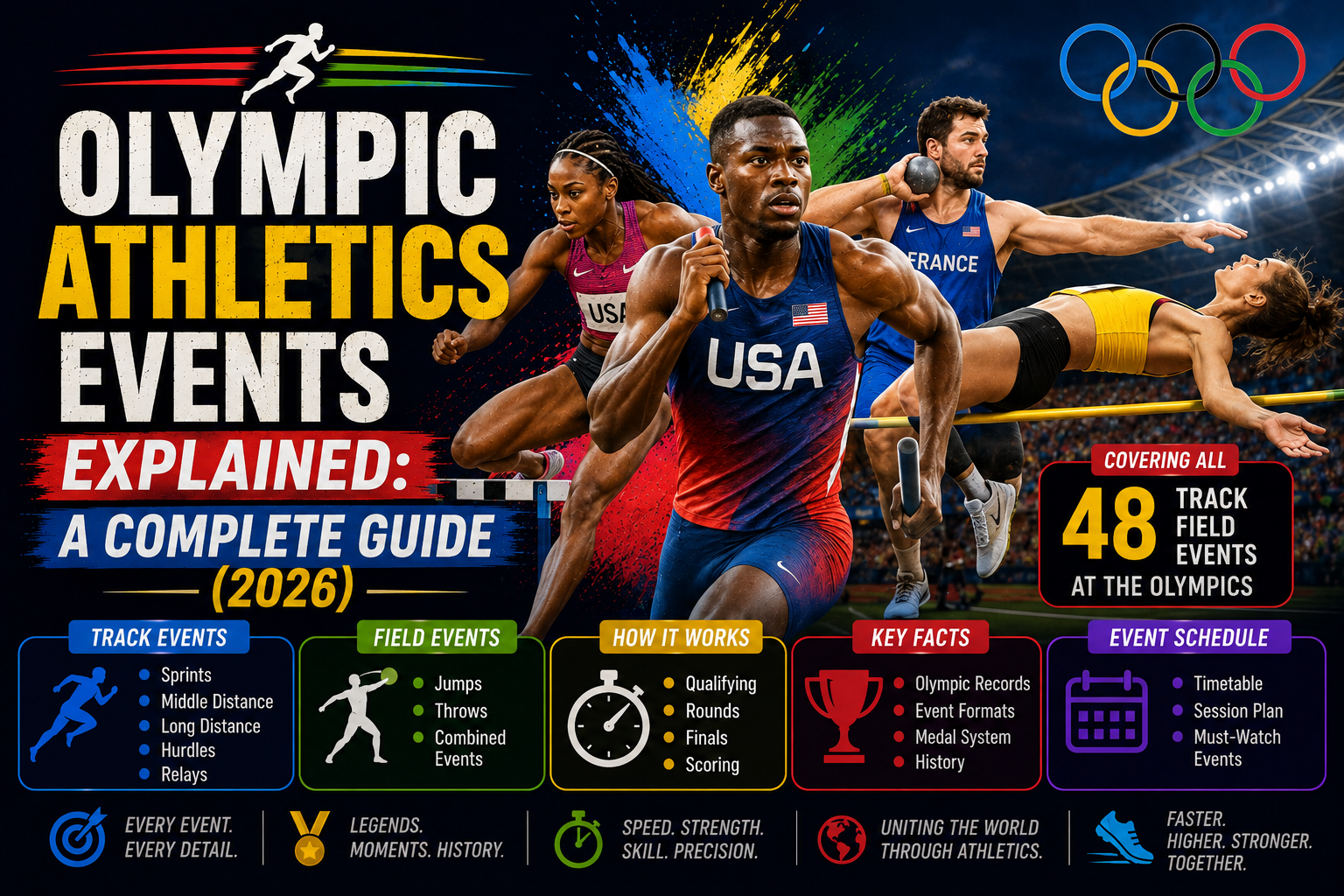
Track and field at the Olympics spreads out in a way that most sports do not. It touches a wide mix of skills, both in the stadium and beyond it. There are 48 separate events in Olympic Athletics events. Some athletes rely on short bursts. Others need to sustain effort for a long time. Judges might keep it simple, or they may go deep, depending on the meet. You might wonder why a sprinter and a shot put thrower end up in the same athletics program. This guide walks through the Olympic track and field events. It also shows how each event runs and what makes each one distinct.
Article Contents
The Four Categories of Olympic Athletics Events
Olympic athletics is run under World Athletics. The sport is usually grouped into four main types. Track events are races held on the track. Field events include jumping and throwing. Some events combine multiple disciplines in one test. The decathlon and heptathlon are the clearest examples. Other events happen away from the stadium track. The marathon and race walking are in that group. Once you place an event in the right category, the rules and timing usually make more sense. You can also see why elite athletes often focus on one path instead of trying to cover everything.
Track Events Explained
Track races are a good entry point for a lot of people. You can picture the rule right away. The first runner over the line takes the win. Times get recorded very carefully. Even tiny gaps can decide the outcome. Track meets also organize events by distance. Some races focus on short, quick speed. The 100m, 200m, and 400m fall in this group. Runners aim for sharp starts and full effort from the gun. Other events call for more steady control. The 800m and 1500m fit here. In those races, athletes must keep the pace under control, but they still have to accelerate when the moment comes. There are also longer races like the 5000m and 10,000m.
Those are built more around stamina. Runners also need good body positioning for the long stretch. Hurdles bring extra demands on top of speed. Athletes clear obstacles while trying not to ruin their rhythm. Relays, like the 4x100m and 4x400m, add a group task. The baton handoff matters a lot. Plenty of well known teams have missed medals because of exchange issues, even when their top sprinters looked strong on paper.
Field Events Explained
Field events are split into jumps and throws. Long jump, triple jump, high jump, and pole vault focus on height or distance. Each one mixes speed with technique in a different way. Pole vault adds extra steps. The athlete must accelerate hard, then shift into tight control, and reach the right moment for takeoff. That is one reason it feels tough compared with many other events. Mondo Duplantis has shown how careful technical changes can lift results, even in an event that has been part of the Olympics for over a hundred years.
The throws — shot put, discus, hammer throw, and javelin — measure distance an implement travels after being launched using a specific, event-regulated technique. Each implement has a different weight and launch mechanic, which is why you rarely see athletes competing seriously across multiple throwing events; the technical skill sets, while related, are specialized enough that switching between them at an elite level is genuinely rare.
Combined and Road Events
The decathlon, for men, uses ten events. The heptathlon, for women, uses seven. Both run across two days. Points are calculated with a single scoring chart. Winning the decathlon or heptathlon is often treated as a top test for overall athletic ability. You cannot focus only on one specialty. You need solid work across sprinting, jumping, and throwing. Most athletes train for just one area, not all of them at the same time.
Then there are the road events. The marathon and race walking are not kept inside the main stadium. They usually run through city streets. Near the end, many athletes still enter the stadium to finish a lap on the track, in front of the full crowd. The marathon in particular carries huge symbolic weight, closing out the athletics program on the final weekend of the Games in most Olympic cycles.
How Olympic Athletics Qualifying Works
Qualifying for the Olympics works in two main ways. One way is to reach a required entry time or mark set by World Athletics. The other way is to qualify by world ranking during the allowed window. This means the field is not simply made up of the fastest names. The field also includes athletes who met the strict entry mark. It can also include athletes who stayed strong over the full qualifying window, even if they did not reach the qualifying standard time.
Why Some Olympic Athletics Events Get More Attention Than Others
The 100m final still gets the most eyes on the athletics schedule in nearly every Olympic year. That is mostly because the race ends in about ten seconds. A viewer can spot the winner right away. It also gives the champion the unofficial badge of being the fastest person on earth. The 200m and the marathon can pull in large crowds too, but for different reasons. Noah Lyles’ 200m is often liked because the run needs more feel for pacing and a clean run through the curve.
The marathon is a long test. It lasts for hours, and the story keeps building as runners fatigue. Field events such as the pole vault and the hammer throw can take a lot of skill. Even so, they often draw fewer mainstream viewers. The usual format slows the action. There are long pauses between attempts, and the key details can be hard for casual fans to read. A short sprint that ends quickly fits television much more easily.

Kumkum Mohod: Age, Asian Games Gold and the Rise of
Kumkum Mohod, a 17-year-old recurve archer from Amravati, Maharashtra, made history when she won India’s first individual recurve gold at…

Sree Charani: Age, Height, Stats and the Record-Setting Rise of
Sree Charani, a left-arm bowler from Andhra Pradesh, is currently the top-rated bowler in the history of ICC Women’s T20I…

Emily Austin: Biography, Career & Net Worth
Emily Austin turned a pandemic-era Instagram Live series into a career as one of the most recognizable young faces in…

Sky Brown: Biography, Skateboarding Career & Net Worth
Skateboarding phenomenon Sky Brown became Britain’s youngest-ever Olympic medalist at 13 years old. Her remarkable career achievements also include a…

Kinsey Wolanski: Biography, Age, Height, Career & Net Worth
Kinsey Wolanski gained recognition as a model and social media personality for disrupting the 2019 Champions League Final and subsequently…

Rachel Stuhlmann: Age, Height, Boyfriend, Tennis Career & Net Worth
Rachel Stuhlmann is an American tennis media personality and a former NCAA Division I player at the University of Missouri….
1 thought on “Olympic Athletics Events Explained: A Complete Guide (2026)”