
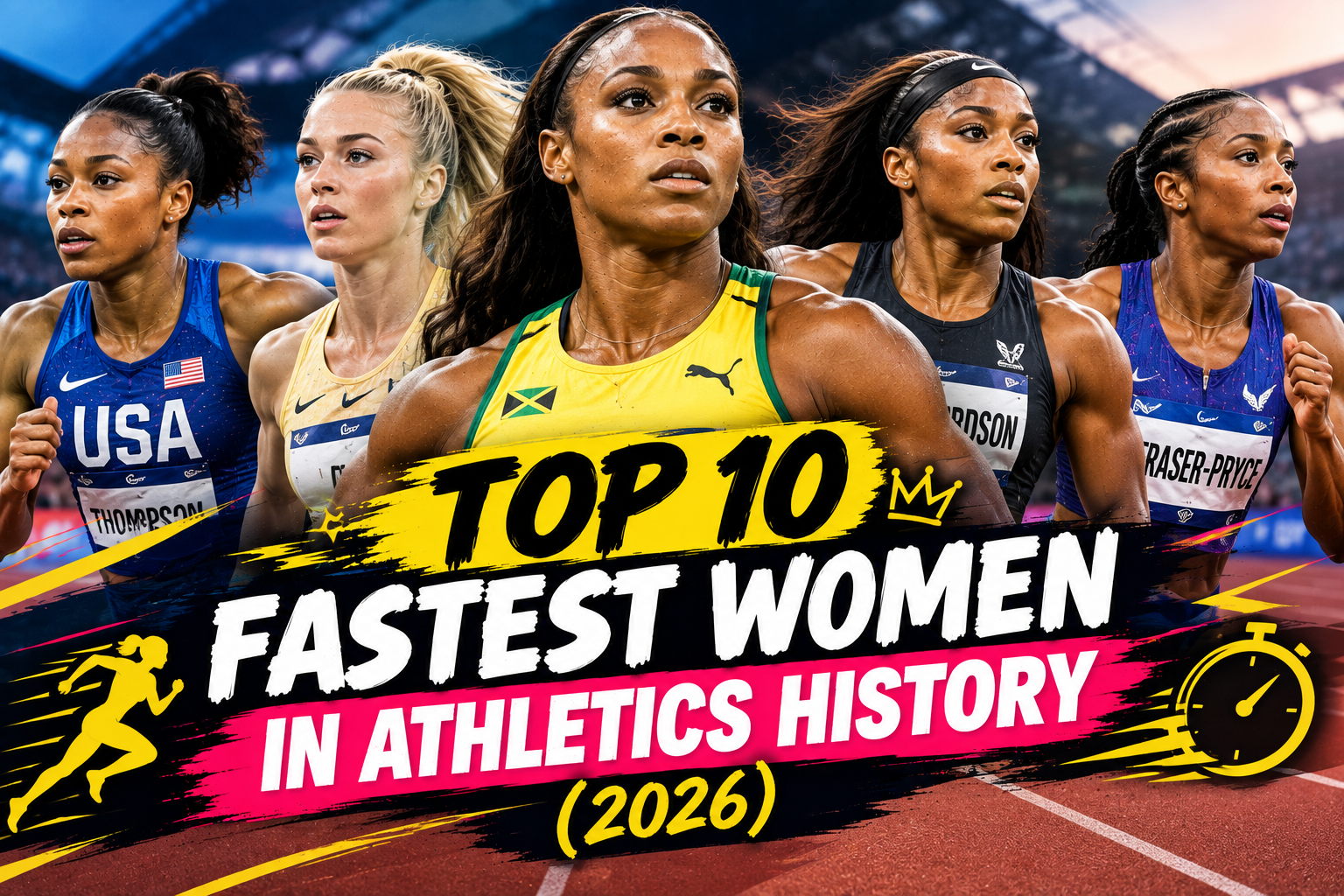
One women’s 100m world record has stood since 1988. Not “stood for a while”—stood since before most of the athletes currently chasing it were born, through entire eras of sprinting talent that couldn’t get within a few tenths of it. When you look at the Fastest Women in Athletics, that gap between the top of the list and everyone else is the single most remarkable fact in women’s sprinting history.
Article Contents
How Fastest Women in Athletics List Was Compiled
This ranking is based primarily on 100m personal bests, the clearest single metric for comparing sprinters across different eras. Wind-legal status, timing technology changes over decades, and occasional disputes over specific marks mean any “fastest ever” list involves some judgment calls — verify exact times against World Athletics’ official records database before citing a specific figure, since this list prioritizes historical accuracy over precise-to-the-hundredth ranking order.
1. Florence Griffith-Joyner
People still call Griffith-Joyner “Flo-Jo.” In 1988, she ran the 100 m in a time that is still the women’s world record today. It is the longest lasting 100 m record, no matter if you look at men or women. She also holds the 200m world record from the same year. No sprinter since, across nearly four decades of professional athletics, has come within a few tenths of either mark, a gap that’s almost unheard of in a sport where records typically fall in small increments every few years.
2. Elaine Thompson-Herah
Thompson-Herah has won Olympic gold in the 100 m and 200 m more than one time. She also owns the second quickest legal mark in the 100 m. After Griffith-Joyner set that record, nobody has matched it closely. Her long stretch of strong results over different Olympic Games is why she is listed among the most decorated sprint athletes.
3. Shericka Jackson
Jackson put up the second-fastest 200m time in history. She was only behind Griffith-Joyner’s long-standing mark. At the same time, she has logged top-level 100m races too. That mix is why she can hurt you in both events, not just one.
4. Carmelita Jeter
Jeter once held the third-fastest wind-legal 100m mark for a long time. That best was set in an era when US sprinting seemed to produce more than one real world record threat at once. Her years also overlapped with other athletes who show up in this list. That is part of why the numbers from that period look so strong.
5. Shelly-Ann Fraser-Pryce
Fraser-Pryce has a strong case as the most decorated sprinter in the event. She leads by medal count. Her career stretched across parts of two decades. She also added multiple Olympic and World Championship 100m titles. Few sprinters, either women or men, have kept elite form for that long.
6. Sha’Carri Richardson
Sha’Carri Richardson has posted some of the quickest legal 100m times from her group. She brings real top-end speed when it matters in big meets. She is also widely known outside the track, which has helped her become one of the most visible names in today’s sport.
7. Tori Bowie
Asher-Smith owns the European record. She has also been a top British sprinter for about ten years. Her results suggest elite sprint speed does not only come from the usual American and Jamaican teams.
8. Dina Asher-Smith
Asher-Smith holds the European record and has been Britain’s standout sprinter for the better part of a decade, proving that elite sprint talent isn’t confined to the traditional American and Jamaican sprinting powerhouses.
9. English Gardner
Gardner won Olympic gold in the 4x100m relay with the United States. Her 100m personal times put her in the group of the fastest runners from her era. That said, she does not have a well known individual global title that matches her speed.
10. Gail Devers
A two-time Olympic 100m champion in the 1990s, Devers’ career is a reminder that this list spans generations, not just one statistically stacked era — her times held up as elite well before modern training and recovery science gave later sprinters additional advantages.
Will Flo-Jo’s Records Ever Fall?
From time to time, people point to a new sprinter and say she could finally beat the times set in 1988. That hope often does not end up changing the record. This era includes runners like Julien Alfred, who have the chance to reduce the gap in the next few years. Still, after nearly forty years, the best athletes have not pushed the times closer than a few tenths. That pattern hints these marks may sit on a higher level, not just a goal that will fall with the next wave.

Genie Bouchard: Biography, Tennis Career & Net Worth
Genie Bouchard is the first Canadian player to win a Grand Slam. This distinction and a No. 5 world ranking…
Tara Davis-Woodhall: Biography, Long Jump Career & Net Worth
Tara Davis-Woodhall is the reigning Olympic gold medalist and current world No. 1 in the women’s long jump, known as…

Sonay Kartal: Age, Height, Ranking and the Comeback That Reached
British player Sonay Kartal was born in 2001. When she qualified for the final of the Wuhan Open in October…

Brittany Mahomes: Biography, Soccer Career & Net Worth
Brittany Mahomes built a career in soccer long before she became known as Patrick Mahomes’ wife — a college career…

Maja Chwalinska: Age, Height, Ranking and the Qualifier Who Reached
Maja Chwalinska, 25, is a Polish tennis player ranked world No. 22. Her breakthrough came in 2026, when she reached…

Kumkum Mohod: Age, Asian Games Gold and the Rise of
Kumkum Mohod, a 17-year-old recurve archer from Amravati, Maharashtra, made history when she won India’s first individual recurve gold at…