
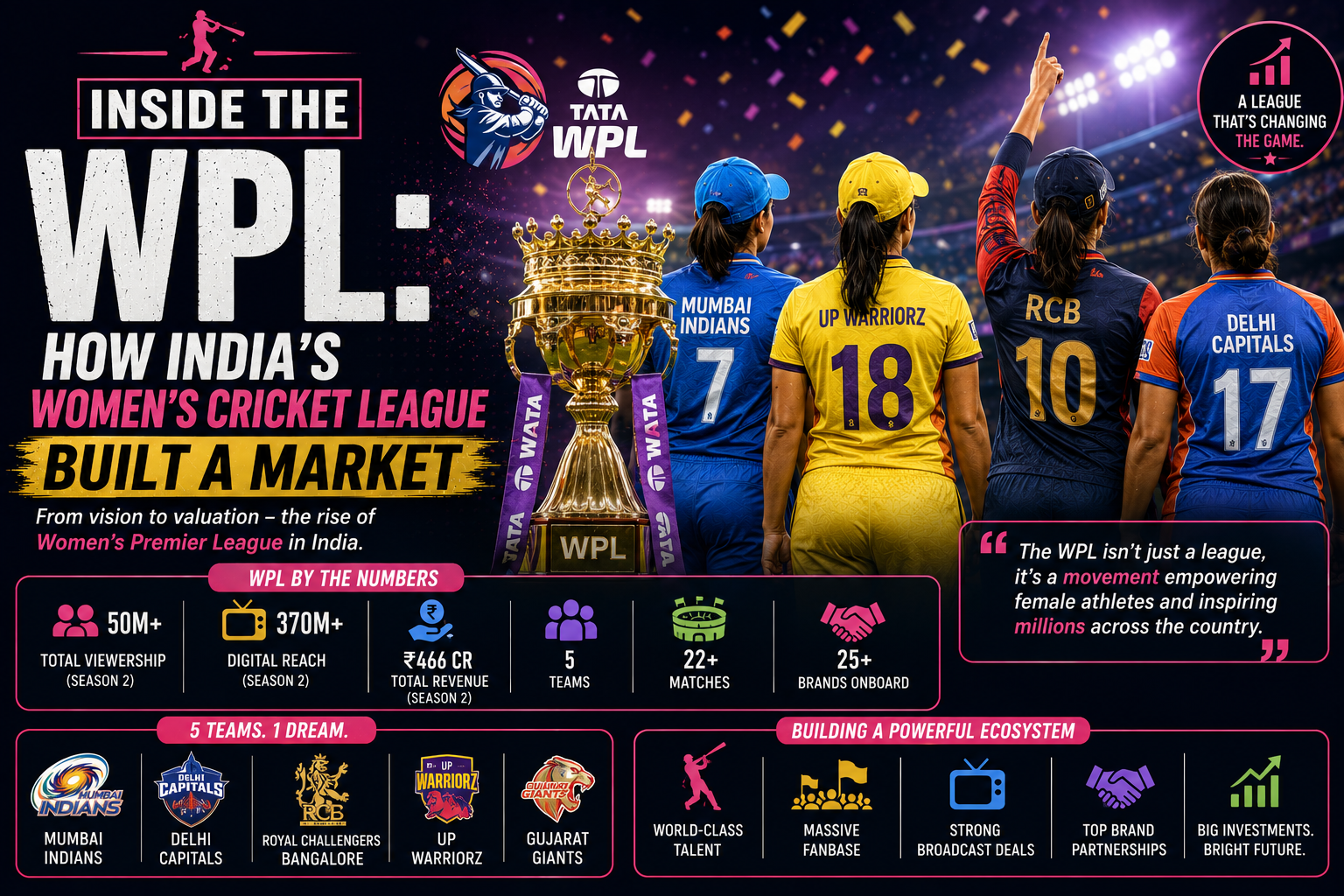
In 2022, the entire Women’s Premier League didn’t exist. By its first auction in 2023, five franchises had paid a combined 4,669.99 crore rupees (roughly $572 million) just for the media rights, and individual player price tags were routinely clearing a million dollars for players who, a year earlier, had no domestic league paying them a salary at all. That jump — from nothing to nearly six hundred million dollars in media rights alone — is the real headline of Indian women’s cricket, bigger than any single player’s batting average.
Article Contents
Why the WPL Launched When It Did
The BCCI had run a scaled-down Women’s T20 Challenge exhibition alongside the men’s IPL for several seasons before the WPL — three or four teams, a handful of matches, barely any broadcast push. It worked as a proof of concept more than a product. What actually forced the board’s hand was some pressure mixed with opportunity, like a little push here and a door suddenly open there. The Hundred in England and the Big Bash in Australia had already shown that women’s domestic T20 could pull genuine broadcast numbers, and Indian cricket’s administrators did not really want to be the last major board still treating women’s cricket like some kind of preseason sideshow.
The Auction Numbers That Changed the Conversation
Numbers do more convincing than adjectives here. Smriti Mandhana then became the most expensive player in the inaugural auction, and by 2023 the total player spend across five franchises had crossed 59 crore rupees in a single auction cycle, meaning real money going to women cricketers, in a market where, a year earlier , there was almost no domestic professional infrastructure for them.
Compare that with what a state level women’s cricketer earned before the WPL , which was often closer to a modest monthly stipend than an actual salary. The gap between those two figures is pretty much the whole story of what changed.
What the WPL Did for Player Careers
Money is the easiest thing to point at, but it isn’t the only shift. Repetition matters just as much. Before the WPL, a young Indian batter might play a dozen high-pressure domestic innings a year if she was lucky.
The league multiplied that overnight, and the effect shows up fastest in players who debuted young — more matches against better bowling attacks, faster technical development, and a level of public visibility that turns a promising junior into a household name inside a single season rather than a decade — the same jump that took a player like Deeya Yadav from unknown to WPL headline within months.
The Gaps That Still Exist
It would be dishonest to frame this as a solved problem. Five WPL franchises is still a fraction of the IPL’s ten, which means far fewer contracted roster spots overall — most domestic women cricketers in India still aren’t on a WPL payroll at all.
Grassroots infrastructure outside the metro cities remains thin compared to the men’s pipeline, and the wage gap between WPL top-bracket salaries and IPL top-bracket salaries, while narrower than it was, is still wide. A league can create a market at the top without yet fixing the pipeline that feeds it. Players like Shafali Verma are the clearest evidence of what the league gets right when it works.
How the WPL Compares to Other Global Women’s Leagues
The WPL didn’t launch into a vacuum. England’s Hundred and Australia’s Big Bash had already spent several seasons proving that a standalone women’s T20 product could draw genuine broadcast numbers, not just goodwill coverage. What the WPL did differently was launch with Indian-sized ambition from day one — a full standalone auction, marquee sponsor categories, and prime broadcast windows rather than a slow multi-year build.
That’s partly a function of the market it was entering: India’s appetite for T20 cricket, already proven by more than fifteen years of IPL data, gave broadcasters and sponsors a level of confidence that other boards had to earn more gradually.
The result is a league that, on pure financial terms, out-earned its older counterparts within a single season of existing. That doesn’t mean the WPL has surpassed the Big Bash or the Hundred in playing standard or global talent depth — it hasn’t, not yet — but on the specific metric of how fast a women’s league can become commercially significant, the WPL set a new benchmark almost immediately.
What This Means for the Next Generation
The clearest long-term impact of the WPL won’t show up in this year’s auction totals. It’ll show up a decade from now, in the career trajectories of girls who are currently ten or eleven years old and watching a professional women’s cricket league on the same channel, in the same production quality, as the IPL. Representation does something that funding alone can’t — it changes what a kid believes is actually available to her before she’s old enough to know the word “career.”
The honest caveat is that this only works if the league’s financial base stays solid past its early hype cycle. Plenty of ambitious sports leagues have launched to strong first-season numbers and then struggled to sustain them once the novelty wore off. The WPL’s challenge now isn’t proving it can generate a big number once — it already has. It’s proving that number holds, or grows, across seasons five, six, and ten.
FAQs
When did the WPL launch?
The first season was played in March 2023 (details on the official WPL website), following an inaugural player auction in February that year.
How many teams compete in the WPL?
Five franchises, compared to ten in the men’s IPL.
Who owns the media rights to the WPL?
Viacom18 acquired the media rights for the inaugural cycle, paying a combined figure in the hundreds of millions of dollars — verify the current rights holder before publishing, as broadcast deals are periodically renegotiated.
Does the WPL pay as well as the IPL?
Not exactly at the very upper end yet, but the gap has narrowed quite a lot since 2023, and WPL top-bracket contracts now substantially exceed what any domestic women’s cricket contract paid before the league was even a thing.
For more coverage stay with sportshail.com.
Jyothi Yarraji: Biography, Athletics Career & Achievements
Jyothi Yarraji holds the Indian national record in the 100m hurdles. She was the first Indian woman to go under…

Emma Raducanu: Biography, Tennis Career & Net Worth
Emma Raducanu became a well known name in 2021. She won the US Open as a qualifier. She was not…

Angel Reese: Age, Stats, Dream Playoff Run & Ultimate Bio
Angel Reese biography: age, stats, Atlanta Dream career, 2026 Defensive Player of the Year and her first WNBA playoff run….

Katie Feeney: Age, Height, ESPN Salary & Net Worth
Katie Feeney turned a college social media hobby into one of the most unusual career paths in modern sports media…

NFL Week 5 Predictions 2026: Picks & Scores for Every
NFL Week 5 predictions for 2026: score picks, odds and key storylines for all 15 games, plus our upset of…

Cowboys vs Buccaneers Prediction: TNF Week 5 Odds & Pick
Cowboys vs Buccaneers prediction for Thursday Night Football on October 8: odds, injuries, expert picks and our score pick….