
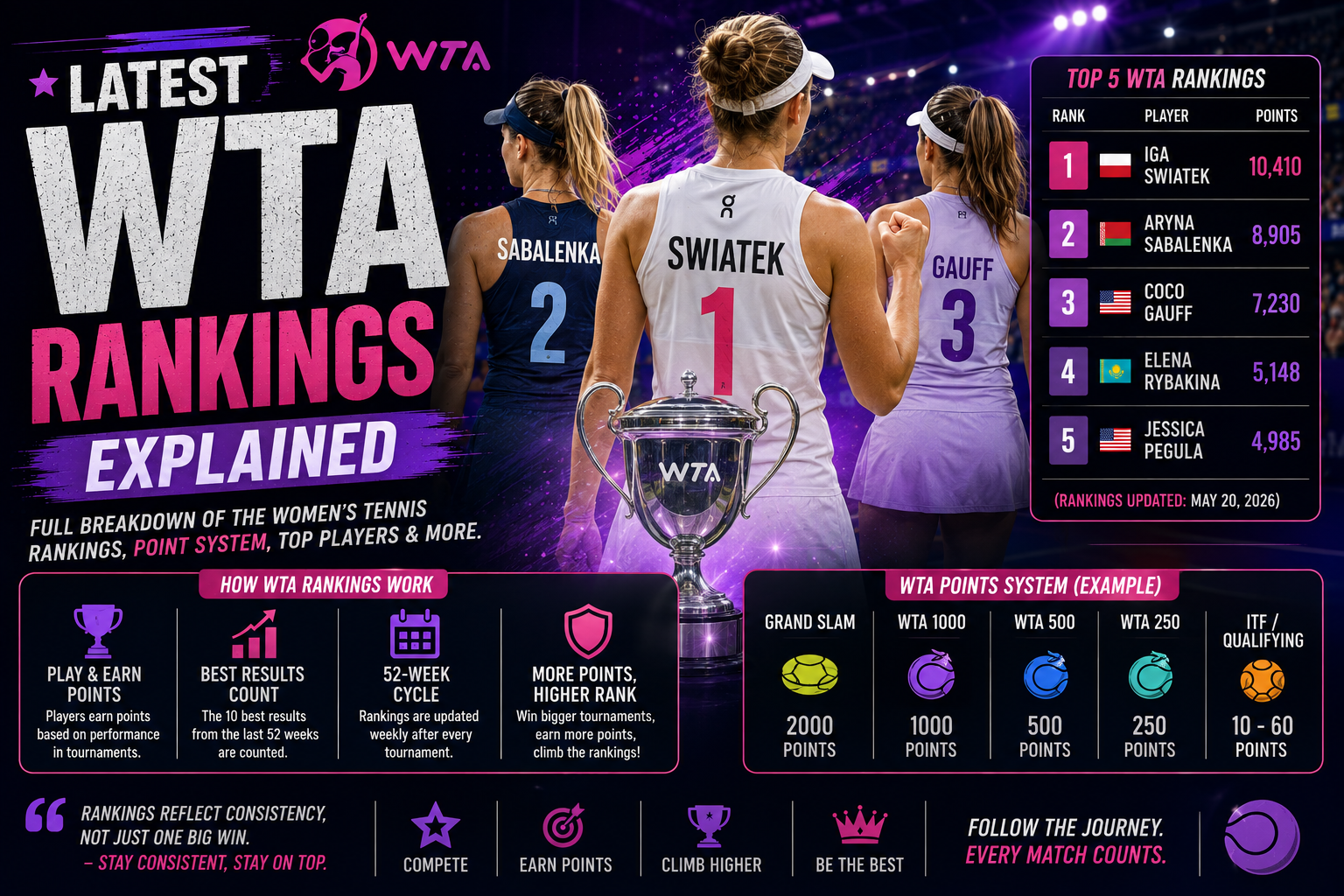
If you glanced at the WTA rankings this week and did a double take at how close the gap has gotten between the top four, you’re reading it right. Women’s tennis has been going through one of its most competitive stretches in years, and the current WTA rankings mirror that pretty directly — the No.1 spot has swapped hands more than once this season, and the crowd of contenders right behind it is packed tighter than at almost any point this decade. Here’s a full breakdown of how the ranking system works, more or less, and then where things are sitting at the moment.
Article Contents
How the WTA Rankings System Actually Works
Women’s tennis has been going through one of its most competitive stretches in years, and the current WTA rankings mirror that pretty directly — the No.1 spot has swapped hands more than once this season, and the crowd of contenders right behind it is packed tighter than at almost any point this decade. Here’s a full breakdown of how the ranking system works, more or less, and then where things are sitting at the moment.
Points earned at a tournament expire exactly a year after that event, which is why a player can drop several spots without losing a single match: the points from a big run 12 months ago simply age off the board. Unlike golf’s rankings, there’s no separate weighting curve inside that 52-week window — a title is a title whether it was won last week or eleven months ago, as long as it’s still inside the rolling year.
Current Top 10 WTA Rankings
Rankings shift weekly — verify the current top 10 against the official WTA rankings page before publishing, since this section should be updated at time of posting rather than left as a static snapshot.
The Storylines Behind the Numbers
The rankings table shows the order, not the whole narrative. Players like Aryna Sabalenka and Coco Gauff have basically been living inside that title race. But the more interesting storyline in women’s tennis lately is the depth that’s grown between around No.3 and No.15 — that separation used to feel way wider, and now it’s thin enough that one solid tournament run can reorder five names at once. This volatility is sort of great for the sport commercially too. Broadcasters like the “not knowing,” and an honestly open top makes casual viewers stick around longer in later rounds, rather than disappearing the moment one player looks like they’re cruising.
Grand Slam vs. Regular Event Points
Yeah, not all WTA ranking points have the same “heft”, and the gap there is bigger than most fans probably think it is. A Grand Slam trophy, you know, carries about twice the value of a WTA 1000 title, so it can happen that someone gets bounced in the first round of three straight 250-level tournaments and still barely changes in the rankings.
At the same time, one real deep run at a Grand Slam can shove a player up ten or fifteen spots, pretty much inside only a couple weeks. And that kind of emphasis is not just random. It keeps the four majors as the clearest ruler in the sport, even as the calendar has gotten more packed with more crowded with mandatory 1000-level events.
There’s a strategic wrinkle here too. Because only a player’s best results count toward certain tour-level bonus systems, some players sort of quietly decide which 250 and 500 events they enter , based on how thin the draw is, not on chasing every ranking point that’s theoretically out there. It’s a calm little numbers thing, it almost never makes headlines but it really steers scheduling decisions across the whole season.
How to Actually Read Ranking Movement
So a player jumping five spots in the WTA rankings in one week doesn’t always mean she played well , or at least not in the way fans assume. Just as often, it means the players above her lost early and shed a chunk of expiring points at the same time she stood still. That’s the part rankings tables never explain on their own — movement can come from below just as easily as it comes from above.
A more usable way to read the WTA rankings, especially mid season, is to ignore the numbers for a second and pay attention to the points gap between neighboring spots. Like, going up three places from No. 8 to No. 5 can bring a huge points swing, but moving three places from No. 38 to No. 35 can be almost nothing, just a tiny rearrangement. The further down the list you go, the more compressed and volatile the points totals get.
FAQs
How often do WTA rankings update?
Every Monday, after the previous week’s tournaments conclude.
How far back do WTA rankings count results?
A rolling 52-week window. Also, points from any tournament expire exactly one year after that event.
What’s the difference between WTA 1000, 500, and 250 events?
The tier basically decides how many ranking points and how much prize money are available. 1000-level events sit just under Grand Slams in points value, while 500s and 250s provide progressively less.
Can an injured player protect their ranking?
Yes, through a Special Ranking exemption, which lets a player returning from a long-term injury enter a limited number of tournaments using their pre-injury ranking.
For more coverage stay with sportshail.com.

Jyothi Yarraji: Biography, Athletics Career & Achievements
Jyothi Yarraji holds the Indian national record in the 100m hurdles. She was the first Indian woman to go under…

Emma Raducanu: Biography, Tennis Career & Net Worth
Emma Raducanu became a well known name in 2021. She won the US Open as a qualifier. She was not…

Angel Reese: Age, Stats, Dream Playoff Run & Ultimate Bio
Angel Reese biography: age, stats, Atlanta Dream career, 2026 Defensive Player of the Year and her first WNBA playoff run….

Katie Feeney: Age, Height, ESPN Salary & Net Worth
Katie Feeney turned a college social media hobby into one of the most unusual career paths in modern sports media…

NFL Week 5 Predictions 2026: Picks & Scores for Every
NFL Week 5 predictions for 2026: score picks, odds and key storylines for all 15 games, plus our upset of…

Cowboys vs Buccaneers Prediction: TNF Week 5 Odds & Pick
Cowboys vs Buccaneers prediction for Thursday Night Football on October 8: odds, injuries, expert picks and our score pick….