
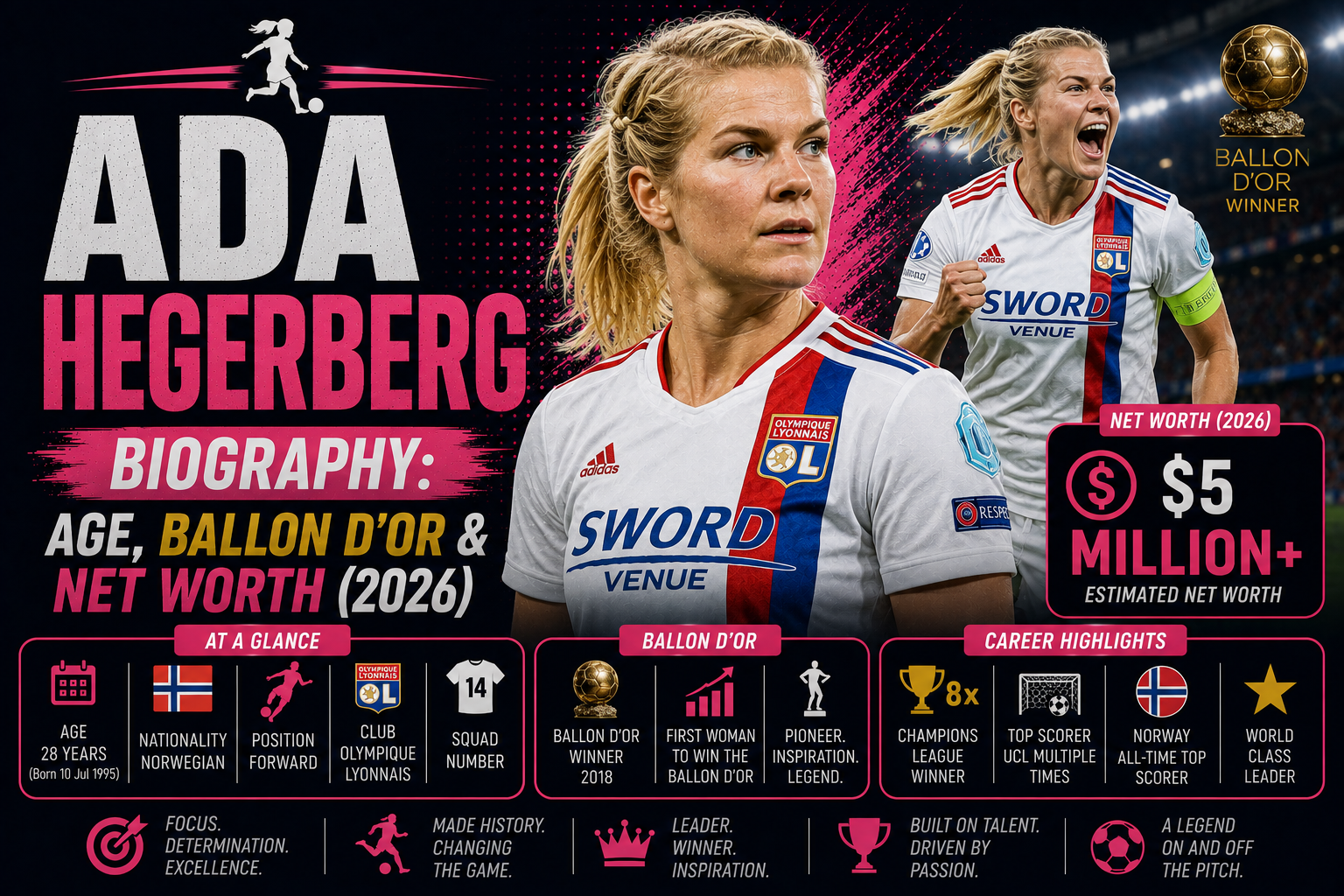
In 2018, Ada Hegerberg stepped onto a stage in Paris. She was there to take the first Ballon d’Or Féminin. This was the women’s version of the biggest solo prize in football. A few seconds later, the host told her to twerk. He said it while she was still on stage. It happened right then, when people were meant to mark what she had achieved on the pitch. The video spread fast. It went viral for the obvious reasons. Later, the moment stuck in people’s minds more than her football did.
Article Contents
Who Is Ada Hegerberg?
Ada Hegerberg is from Norway. She works as a striker. She was the first player to take home the Ballon d’Or Féminin. That prize exists to celebrate women’s football in a way that matches how the top men’s honor supports the sport on that side. In her club seasons, she mostly stayed with one of the top women’s clubs in Europe. Over that stretch, she kept finding the net with a calm, consistent touch. Because of that output, she is now viewed as one of the more dependable finishers in the game today.
| Full Name | Ada Stolsmo Hegerberg |
| Profession | Professional Footballer (Striker) |
| Date of Birth | July 10, 1995 |
| Birthplace | Molde, Norway |
| Position | Striker |
| National Team | Norway |
| Major Honors | Ballon d’Or Féminin (inaugural winner), multiple Champions League titles |
| Nationality | Norwegian |
| Estimated Net Worth | $3-6 million (estimated, salary + endorsements) |
Ada Hegerberg Age and Early Career
She was born on July 10, 1995, in Molde. Growing up, she played football with her sister. Her sister later became a pro too. Their home treated the women’s game as a real career route. This was before it became common across Europe. As a teen, Hegerberg went abroad to keep growing. At the time, that option was not the same for every young player. It was not always pushed or even offered. Still, the move helped her sharpen her skills ahead of many others in her area.
Ada Hegerberg’s Historic Ballon d’Or Win
Her 2018 win for the first Ballon d’Or Féminin mattered. It was a major step for women’s football. The ceremony put the award in the same setting as the men’s prize. For years, women’s football was mostly left out of that kind of talk. Hegerberg’s season leading into the award was statistically dominant enough that there was little argument about the choice itself.
The problem was everything that happened in the thirty seconds after she received it, when the ceremony’s host asked her, live, to twerk. It was a genuinely degrading moment layered on top of a genuine milestone, and the fact that both things are true at once says a lot about where the women’s game still stood in terms of respect, even while breaking new ground.
Ada Hegerberg and the Norway National Team Boycott
During one of the better known moments in modern football, Hegerberg left the Norwegian national team for a few years. She did this because she said there were serious disagreements about how the federation handled the women’s side. She believed the women’s program was not treated or valued the same way as the men’s.
It wasn’t a minor gesture. She missed multiple major tournaments during her absolute prime years as a player — tournaments a player of her caliber would ordinarily expect to headline — as a deliberate stand rather than a scheduling conflict or injury. Not many top players are ready to give up that kind of stage time. Hegerberg chose to do it anyway. Her absence became part of a loud debate on work and fairness in the sport during those years.
Ada Hegerberg Club Career and Goal-Scoring Record
While the national team fight was still ongoing, her club work did not pause. She kept scoring and rose as a sharp striker in European women’s football. In that stretch, she helped her club win major league titles and also take continental honors. Those results helped make her club the top team in the sport at the height of her form.
Her goals did not just stand out in domestic play. In the Champions League, she was especially strong. Her output put her among a small group of players with steady numbers. Because she was not on the international stage, it felt like a double hit. Norway could have used that kind of finishing in big tournament games.
Ada Hegerberg’s Return to the Norway Team
Hegerberg later came back to the national team. She returned after she felt the federation had made real steps toward the issues she had raised. The comeback mattered in more than one way. It was important for what it signaled, and it also helped Norway on the field. With her back, Norway regained a reliable scorer. They had missed her finishing in the exact tournaments where it counts most. It also closed the loop on a story that, at its core, was never really about one player’s ego — it was about whether a federation would actually listen when a generational talent said the current setup wasn’t good enough.
Ada Hegerberg’s Broader Impact on Women’s Football
It’s easy, years later, to reduce Hegerberg’s story to two headline moments — the twerk request and the boycott. Both mattered, but neither fully captures what she actually did for the sport’s visibility. Young strikers coming through European academies now grow up with a genuine Ballon d’Or Féminin to aspire toward, an award that exists in its current form partly because Hegerberg’s dominant early seasons made the case for it impossible to ignore.
Her willingness to walk away from her own national team, at real personal and competitive cost, also became a reference point other players in other countries pointed to during their own disputes over pay and treatment. That’s a harder legacy to put a number on than goals scored, but it may end up being the more lasting one.
Ada Hegerberg Net Worth
Exact contract figures aren’t always publicly disclosed in full for women’s football, so treat any number as an informed estimate. Combining club salary, Champions League and domestic bonuses, and an endorsement portfolio that’s grown significantly alongside the profile of the women’s game, financial estimates place her net worth in the $3-6 million range — modest compared to top men’s football salaries, but among the higher end for women’s club football during her career.
For the full ceremony history and past winners, see the official Ballon d’Or archive, and for her domestic and continental match statistics, UEFA’s Women’s Champions League site maintains historical records across her most productive seasons.

Genie Bouchard: Biography, Tennis Career & Net Worth
Genie Bouchard is the first Canadian player to win a Grand Slam. This distinction and a No. 5 world ranking…

Tara Davis-Woodhall: Biography, Long Jump Career & Net Worth
Tara Davis-Woodhall is the reigning Olympic gold medalist and current world No. 1 in the women’s long jump, known as…
Sonay Kartal: Age, Height, Ranking and the Comeback That Reached
British player Sonay Kartal was born in 2001. When she qualified for the final of the Wuhan Open in October…

Brittany Mahomes: Biography, Soccer Career & Net Worth
Brittany Mahomes built a career in soccer long before she became known as Patrick Mahomes’ wife — a college career…
Maja Chwalinska: Age, Height, Ranking and the Qualifier Who Reached
Maja Chwalinska, 25, is a Polish tennis player ranked world No. 22. Her breakthrough came in 2026, when she reached…

Kumkum Mohod: Age, Asian Games Gold and the Rise of
Kumkum Mohod, a 17-year-old recurve archer from Amravati, Maharashtra, made history when she won India’s first individual recurve gold at…
1 thought on “Ada Hegerberg Biography: Age, Ballon d’Or & Net Worth (2026)”